Jinkushal Cardiac Care & Superspeciality hospital


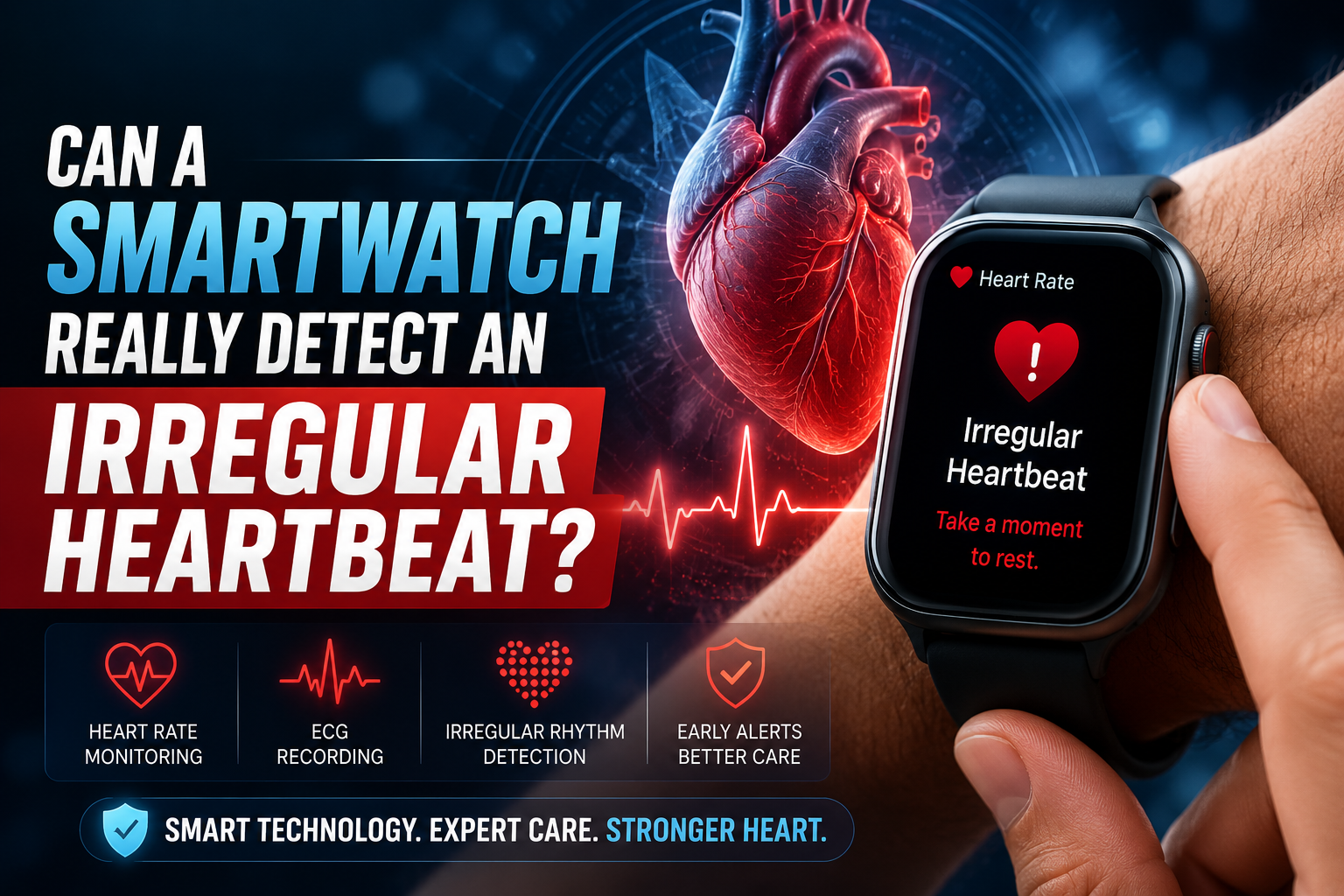
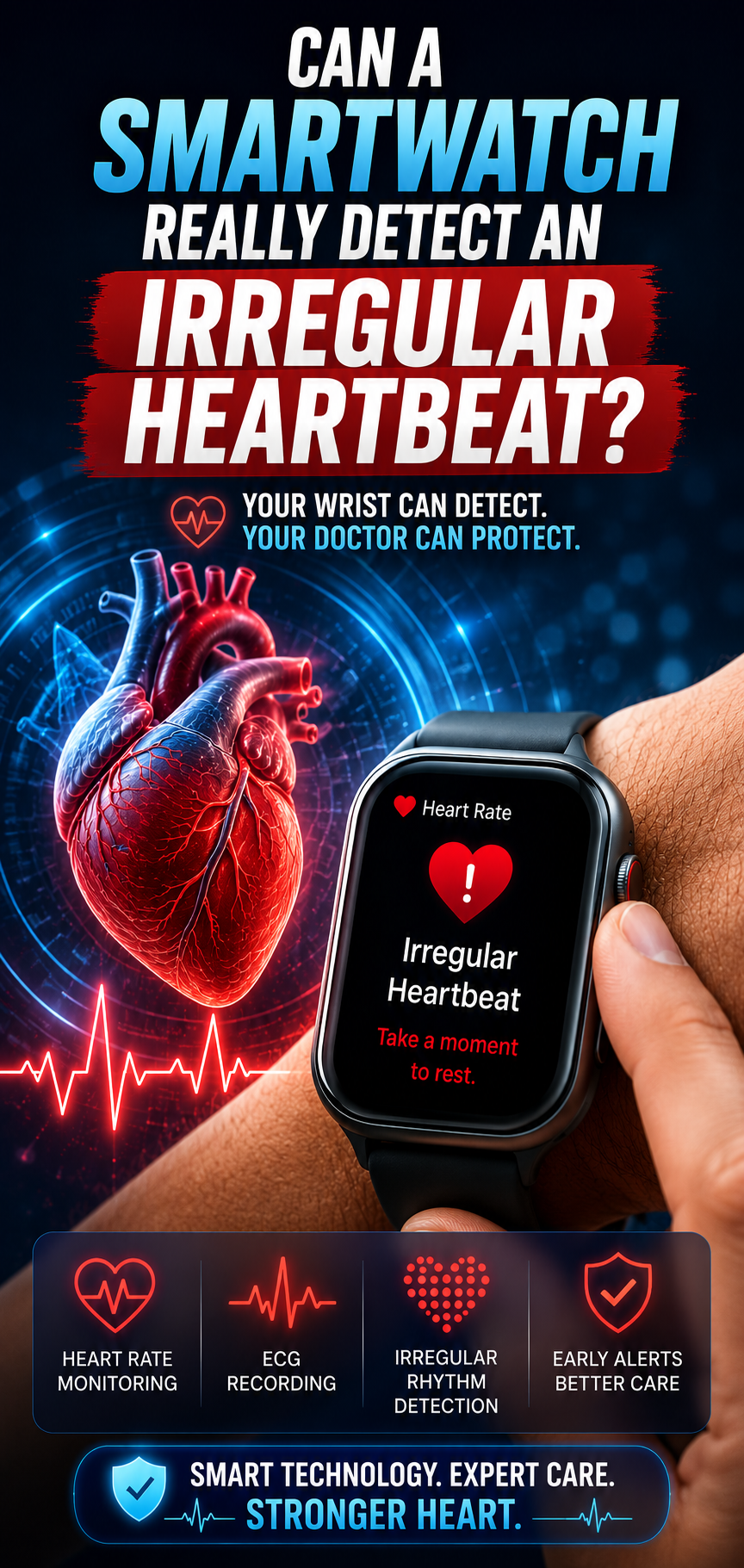
Can a Smartwatch Really Detect an Irregular Heartbeat?
Your smartwatch may be doing more than counting your steps. It could be quietly watching your heartbeat, too.
Imagine this…
You are sitting at your desk, relaxing on the sofa, or taking a morning walk. Suddenly, your smartwatch gives you an alert:
“Your heart rhythm appears irregular.”
You look at your wrist and wonder—
“Can a watch really know something is wrong with my heart?”
The answer is: Yes, sometimes—but with important limitations.
Modern smartwatches have become surprisingly sophisticated. Some can monitor your heart rate continuously, identify unusual patterns, and even record a simplified version of an ECG (electrocardiogram).
But can your smartwatch diagnose a heart problem?
Not by itself.
Let’s understand what your smartwatch can—and cannot—tell you about your heart.

How Does a Smartwatch Monitor Your Heart?
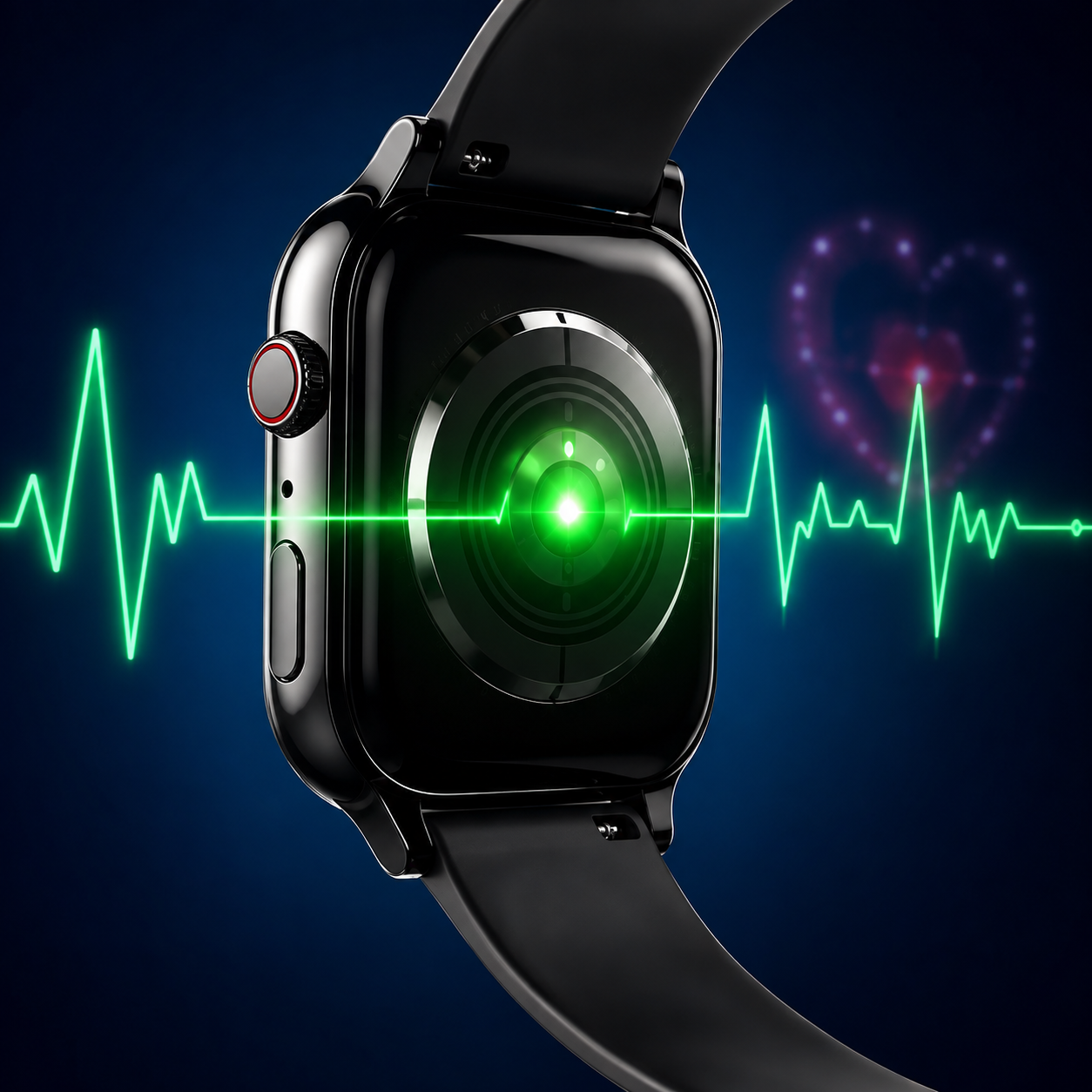
Most smartwatches use sensors placed on the back of the device to monitor your pulse.
One common technology is called photoplethysmography (PPG).
Don’t worry about the complicated name!
In simple terms, the watch uses light to detect changes in blood flow through your wrist with every heartbeat.
It can then estimate:
- ❤️ Your heart rate
- ❤️ Changes in your pulse pattern
- ❤️ Whether your heartbeat appears regular or irregular
- ❤️ In some devices, whether the pattern may be suggestive of atrial fibrillation (AF)
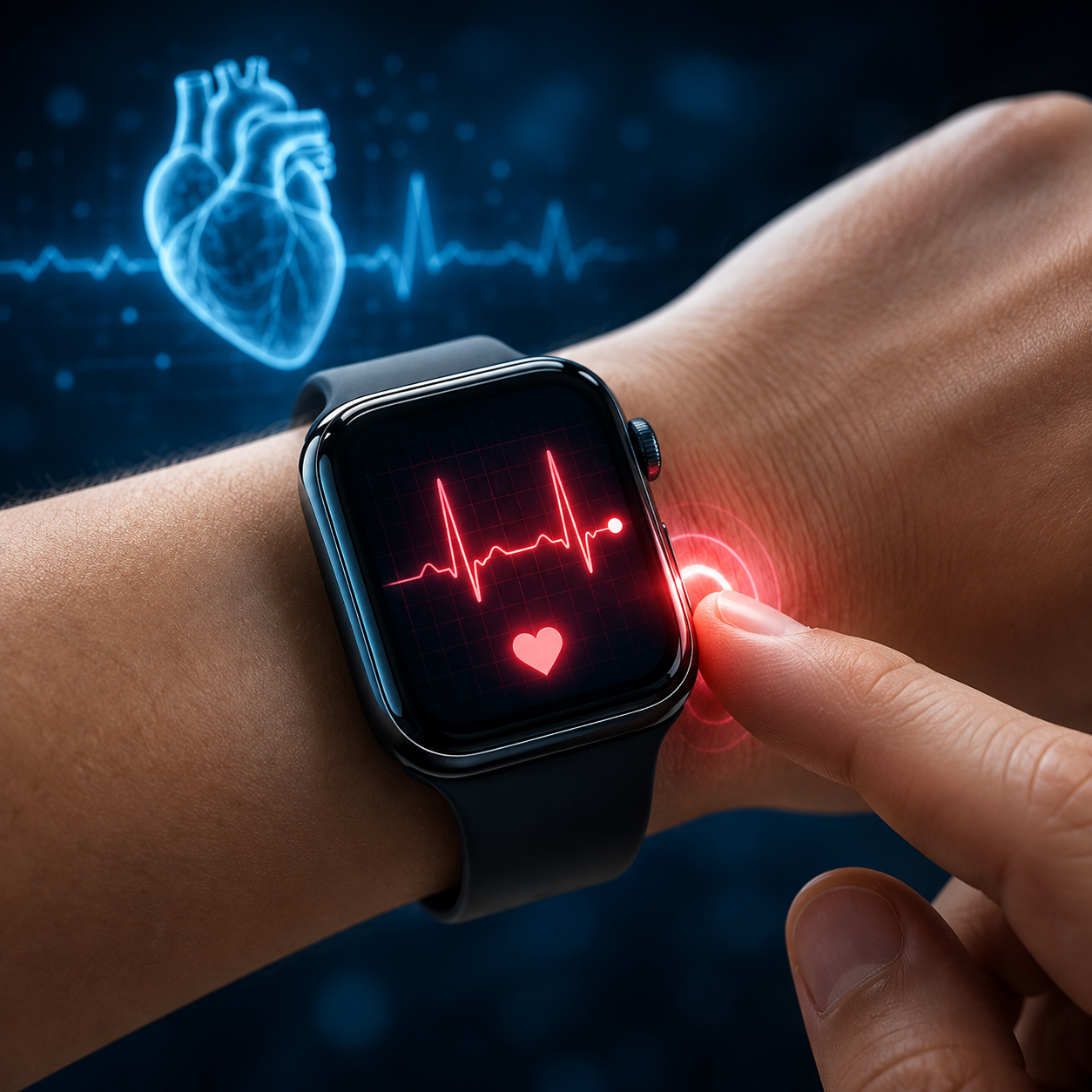
Some advanced smartwatches also have electrodes that can record an ECG when you touch the watch with a finger from your other hand.
That is a major step forward in personal heart monitoring.
What Is an Irregular Heartbeat?
Your heart normally beats in a regular rhythm.
But occasionally, you may feel:
“Thump… thump… pause… thump-thump…”
This may be described as a palpitation or irregular heartbeat.
An irregular rhythm can happen for many reasons.
Sometimes it may be completely harmless—for example, occasional extra beats can occur even in otherwise healthy people.
But in some cases, an irregular rhythm may indicate a condition that needs medical attention.
One of the most important examples is:
Atrial Fibrillation (AF)
Atrial fibrillation is a common abnormal heart rhythm in which the upper chambers of the heart beat in an irregular and often rapid manner.
It matters because AF can increase the risk of blood clots and stroke in some people.
This is where smartwatch technology can potentially become useful.
Can a Smartwatch Detect Atrial Fibrillation?
Some smartwatches can detect patterns that may suggest atrial fibrillation.
They don’t necessarily “see” AF directly.
Instead, sensors monitor the pulse or record an ECG and look for an irregular rhythm pattern.
If the device detects a concerning pattern, it may give you an alert such as:
“Possible irregular heart rhythm detected.”
This can be valuable because atrial fibrillation may sometimes occur intermittently.
A person may have AF for a short period and then return to a normal rhythm before reaching a doctor’s clinic.
A smartwatch may potentially capture an episode that otherwise could have gone unnoticed.

But Here's the Important Catch…
A smartwatch is not a cardiologist.
An alert from your smartwatch does not automatically mean that you have a heart disease or atrial fibrillation.
There can be false alarms.
Your watch may interpret an irregular pulse because of:
- Movement during measurement
- Poor contact between the watch and your skin
- Loose fitting of the device
- Exercise
- Frequent extra heartbeats
- Certain other rhythm disturbances
- Sensor limitations
So, don’t panic if your watch suddenly shows an irregular rhythm.
But also…
Don’t ignore repeated or concerning alerts.
The right response is to discuss them with a healthcare professional.
What About Smartwatch ECG?
Some smartwatches can record a single-lead ECG.
An ECG records the electrical activity of your heart.
A smartwatch ECG is not equivalent to the full 12-lead ECG commonly performed in a hospital or clinic.
However, it can provide useful information in certain situations.
For example, if you experience sudden palpitations and your smartwatch can record an ECG during that episode, the recording may give your doctor additional information.
Think of it as:
Smartwatch = an early clue
Medical ECG + clinical evaluation = proper assessment
What If My Smartwatch Says My Heartbeat Is Irregular?
First:
Don’t panic.
Second:
Don’t simply dismiss it.
If the alert happens repeatedly, or if you are experiencing symptoms, it is sensible to seek medical advice.
Pay attention to symptoms such as:
- Chest discomfort or pain
- Breathlessness
- Dizziness
- Fainting or near-fainting
- Unusual weakness
- Racing or pounding heartbeat
- Persistent palpitations
If you have severe chest pain, significant difficulty breathing, fainting, or other symptoms suggesting a medical emergency, seek urgent medical care rather than relying on your smartwatch.
Can a Normal Smartwatch Reading Guarantee That Your Heart Is Healthy?
No. This is extremely important.
A smartwatch showing a normal heart rate does not mean that every aspect of your heart is normal.
A smartwatch generally cannot rule out conditions such as:
- Blocked heart arteries
- Structural heart disease
- Heart valve problems
- Heart muscle disease
- Many types of arrhythmias
- Other cardiovascular conditions
Your heart health cannot be judged from one number on your wrist.
A healthy heart requires the bigger picture—including your symptoms, medical history, blood pressure, cholesterol, diabetes risk, lifestyle, examination and, when appropriate, medical tests.
So, Should You Trust Your Smartwatch?
Use it as a tool—not as a doctor.
That is perhaps the best way to think about wearable technology.
A smartwatch can be useful for:
✅ Tracking heart rate trends
✅ Detecting some unusual rhythm patterns
✅ Recording certain ECGs on supported devices
✅ Bringing attention to symptoms or rhythm changes
✅ Sharing useful recordings with your healthcare professional
But it should not be used to:
❌ Self-diagnose a heart condition
❌ Start or stop medication on your own
❌ Ignore symptoms because the watch says everything is normal
❌ Assume every irregular reading means atrial fibrillation
The Real Power of a Smartwatch
The biggest benefit of this technology may not be that your smartwatch diagnoses a heart problem.
Its real value may be that it alerts you to something worth investigating.
For example:
“I felt my heart racing at 8:30 PM.”
Your smartwatch may have recorded an unusual heart-rate pattern around the same time.
That information can help you tell your doctor exactly what happened and when.
In some situations, this can be a useful piece of the diagnostic puzzle.
The Real Power of a Smartwatch
Technology is changing the way we monitor our health.
A smartwatch can sit on your wrist all day.
It can collect information while you’re walking, sleeping, exercising, or simply going about your daily routine.
That is impressive.
But when it comes to your heart, data is only the beginning.
The most important step is knowing what that data means.
So if your smartwatch repeatedly alerts you about an irregular heartbeat—or if you experience concerning symptoms—don’t simply reset the watch and forget about it.
Talk to a healthcare professional.
Because when it comes to your heart…
Your smartwatch can raise the alarm.
But your doctor finds the answer. ❤️
Yes, a smartwatch can detect certain irregular heartbeat patterns, and some devices can identify patterns suggestive of atrial fibrillation or record a single-lead ECG.
But a smartwatch cannot replace a medical evaluation.
Think of your smartwatch as an early-warning tool, not a diagnostic machine.
Listen to your body. Use technology wisely. And never ignore important heart symptoms simply because your smartwatch says everything is fine.
❤️ Your heart deserves more than a number on your wrist.
It deserves attention, understanding, and the right medical care.